
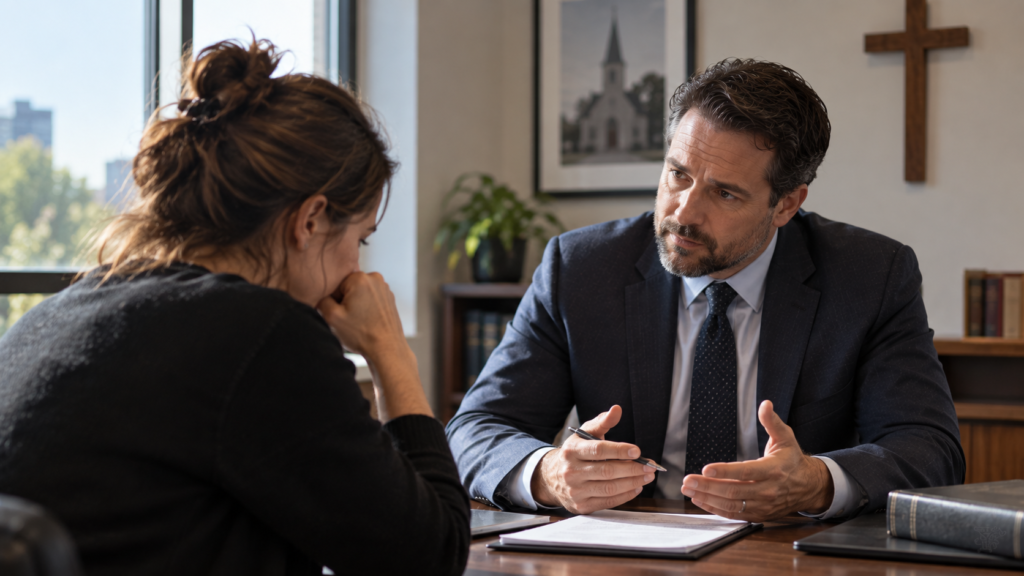
Religious communities often depend on trust. Clergy members may have access to children, families, private counseling conversations, schools, youth programs, and people who are looking for spiritual support during vulnerable moments. When that position of trust is used to exploit or abuse someone, the harm can be difficult to disclose and may continue to affect the survivor long after the conduct ends.
Seeking justice can take several forms. A survivor may choose to report criminal conduct, make a report to child protection authorities when a minor is involved, pursue a civil claim for compensation, or take more than one of those steps. The right path depends on the survivor’s age when the abuse happened, the conduct involved, the evidence, and whether a religious institution or other organization may also share responsibility.
Quick Answer: Clergy abuse generally refers to sexual abuse, exploitation, grooming, coercion, or other serious misconduct committed by a priest, pastor, minister, rabbi, religious leader, or other person using religious authority or access. In Illinois, survivors may be able to report the abuse to law enforcement, protect a child through DCFS, and pursue civil claims against the abuser and potentially an institution that negligently enabled, concealed, or failed to prevent the abuse.
What Conduct Can Be Considered Clergy Abuse?
Clergy abuse is not limited to one type of religious organization or one kind of conduct. It can include sexual contact with a child, sexual assault, grooming, exploitation during counseling, coercive sexual behavior, or the use of spiritual authority to create secrecy, fear, or dependence.
The firm’s church and clergy abuse practice focuses on protecting survivors when religious authority has been used to cause harm. In many cases, the abuse is connected to a larger trust relationship in which the survivor or family believed the clergy member was safe.
Grooming can happen before direct abuse. A clergy member may create special access, isolate a child, offer gifts, normalize boundary violations, or convince the survivor that disclosure would harm the family or religious community. Those patterns can help explain why a survivor did not immediately recognize, resist, or report what happened.
Why Can Clergy Abuse Be Hard to Report?
Survivors may fear that they will not be believed, that the congregation will defend the clergy member, or that speaking up will damage family relationships. Children may not have the language to describe what happened, and adults who were abused as children may need years before they understand the connection between the abuse and later emotional or psychological harm.
Religious authority can add another layer of pressure. A survivor may have been told that the conduct was a secret, that reporting it was sinful, or that the clergy member had special authority. Those messages can make delayed disclosure understandable rather than unusual.
Clergy abuse cases often overlap with broader child abuse claims because the core issue is the exploitation of a child or vulnerable person by someone entrusted with access and responsibility. The legal case can also examine what other adults or institutions knew before the abuse occurred.
Who Can Be Held Responsible in a Clergy Abuse Case?
The individual abuser may be directly responsible for the harm. Depending on the facts, a church, diocese, religious organization, school, youth program, or other entity may also face claims if its own conduct contributed to the abuse.
Institutional claims may involve negligent hiring, retention, supervision, or failure to respond to prior complaints. A case may also examine whether leaders moved an accused clergy member, concealed known allegations, failed to warn families, or continued to provide access to children after receiving warning signs.
An institution is not automatically liable simply because an abuser had a religious title. The evidence must show a legal basis for holding the organization responsible, which is why personnel records, prior complaints, internal communications, assignment histories, and witness testimony can become important.
How Do You Report Clergy Abuse in Illinois?
If a child is in immediate danger, call 911. Suspected abuse or neglect of a child can also be reported to the Illinois DCFS Child Abuse and Neglect Hotline at 800-252-2873. Illinois provides an online reporting option for non-emergency situations.
The firm’s child abuse reporting guidance explains common steps when someone suspects a child is being harmed. A report to a religious organization can be made as well, but an internal church process should not be treated as a substitute for contacting law enforcement or child protection authorities when criminal conduct or child safety is involved.
Adult survivors can report criminal conduct to law enforcement even when the abuse happened years earlier. Whether prosecutors can bring charges depends on the offense and the law that applies, but current Illinois law permits prosecution at any time for many offenses involving sexual conduct or sexual penetration.
Can Survivors File a Civil Lawsuit for Childhood Clergy Abuse?
Potentially, yes. Illinois law has special rules for civil claims based on childhood sexual abuse. The current statute states that an action for damages based on childhood sexual abuse may be commenced at any time, but older claims can still require careful analysis because the statute contains transition language affecting claims that were already time barred under earlier law.
That means a survivor should not assume that a claim is either automatically valid or automatically too old. The date of the abuse, the survivor’s age, when the injury and its connection to the abuse were discovered, prior versions of the law, concealment, and the identity of the defendants can all matter.
General personal injury deadlines do not tell the whole story in clergy abuse cases. Claims involving abuse that occurred when the survivor was an adult may follow different limitation rules from childhood sexual abuse claims.
What Evidence Can Help Support a Clergy Abuse Claim?
Many survivors worry that they cannot bring a claim because there was no police report or medical record at the time. Those records can be helpful when they exist, but abuse cases can also be built with other evidence, especially when the conduct happened years ago.
Potential evidence may include:
- The survivor’s account and any earlier disclosures to family, friends, counselors, or clergy
- Church assignments, personnel records, internal reports, and complaint histories
- Letters, emails, photographs, calendars, school records, or youth program documents
- Evidence of similar allegations involving the same clergy member
- Counseling or treatment records that document the effects of the abuse
- Witnesses who observed grooming, unusual access, transfers, or institutional responses
A survivor does not need to gather every document before speaking with a lawyer. One purpose of a legal investigation is to identify records the survivor may never have had access to and determine how they can lawfully be obtained.
What Compensation May Be Available in a Civil Clergy Abuse Case?
Civil compensation can address the harm caused by the abuse and its long term effects. Depending on the case, damages may include counseling and treatment costs, lost income, reduced earning capacity, pain and suffering, emotional distress, and other losses tied to the abuse.
The value of a claim depends on the evidence, the severity and duration of the harm, the defendants involved, and the available insurance or assets. Some cases may also involve punitive damages when the legal requirements are met, although punitive damages are not automatic.
The firm also handles sexual abuse claims in social services settings, where institutions may be examined for failures in supervision and protection. Although the settings are different, both types of cases can involve questions about whether an organization ignored warning signs or gave an abuser continued access to vulnerable people.
Can You Seek Justice Without Publicly Confronting the Abuser?
Yes. A survivor does not need to personally confront the accused clergy member to begin exploring legal options. Attorneys can communicate with institutions, insurers, and opposing counsel while helping protect the survivor from unnecessary direct contact.
Court cases can involve public filings, but some sensitive information may be protected through legal procedures depending on the circumstances. Settlement discussions can also include confidentiality terms, although a survivor should understand the effect of any confidentiality provision before agreeing to it.
The survivor remains an important decision maker throughout the case. Some people want a public trial, while others value privacy or a negotiated resolution. A lawyer can explain the available routes without assuming that every survivor wants the same outcome.
What if the Religious Institution Knew About Prior Complaints?
Evidence that an organization knew about prior allegations can be significant. It may support a claim that leaders should have limited access, investigated, warned families, removed the clergy member from service, or taken other protective action before additional harm occurred.
The Illinois Attorney General’s 2023 report on Catholic clergy child sex abuse described decades of allegations and institutional handling across Illinois dioceses. A particular civil case still depends on its own facts, but the broader history helps explain why assignment records, prior complaints, and internal communications can be important evidence.
The firm’s published case results include complex abuse and negligence matters involving institutions responsible for vulnerable people. Those results do not predict the outcome of a clergy case, but they show why institutional records and prior warning signs can become central to accountability.
How Can a Lawyer Help a Clergy Abuse Survivor?
A lawyer can first determine which legal rules and deadlines apply, identify possible defendants, and assess whether the institution may share responsibility. The investigation can include obtaining records, locating witnesses, reviewing prior complaints, and working with qualified professionals to document the effects of the abuse.
The lawyer can also deal with insurers and defense attorneys so the survivor does not have to manage those communications alone. In a case involving events from many years ago, legal discovery tools may be especially important because key records are often held by the institution rather than the survivor.
The firm’s legal team represents people in serious abuse and negligence matters and emphasizes detailed case investigation. Survivors can ask questions privately before deciding whether they want to move forward with a civil claim.
Frequently Asked Questions
Is clergy abuse limited to Catholic priests?
No. Clergy abuse can involve leaders or representatives of any religious organization, including priests, pastors, ministers, rabbis, youth leaders, counselors, or others who use religious access or authority to abuse or exploit someone.
Can an adult sue for clergy abuse that happened during childhood?
Possibly. Illinois has special limitation rules for childhood sexual abuse claims, and current law allows many such actions to be filed without a standard time limit. Older claims still require individual review because prior time bars and statutory transition rules can affect whether a claim remains available.
Do you have to report clergy abuse to the church first?
No. A church complaint process is separate from police, child protection, and civil legal options. When a child is at risk or criminal conduct is alleged, reporting only to the religious institution may not be enough to protect others or preserve legal rights.
Can a church be liable for abuse committed by a clergy member?
It can be in some circumstances. Liability may depend on whether the organization negligently hired, retained, supervised, transferred, or failed to act on warning signs about the abuser.
What if there are no records from the time of the abuse?
A case may still be possible. Survivor testimony, earlier disclosures, witnesses, church records, assignment histories, other complaints, counseling records, and institutional documents can all become relevant evidence.
Conclusion
Clergy abuse is a serious betrayal of trust that can involve sexual abuse, grooming, coercion, and institutional failures to protect vulnerable people. Illinois survivors may have criminal reporting options and civil claims against the abuser and, depending on the evidence, the religious institution that enabled or failed to prevent the harm.
The Deratany Law Firm LLC represents survivors of church, clergy, child abuse, and other serious negligence matters. If you are considering your options, a confidential conversation with the firm can help clarify the law, the evidence that may still be available, and the next step that feels right for you.