
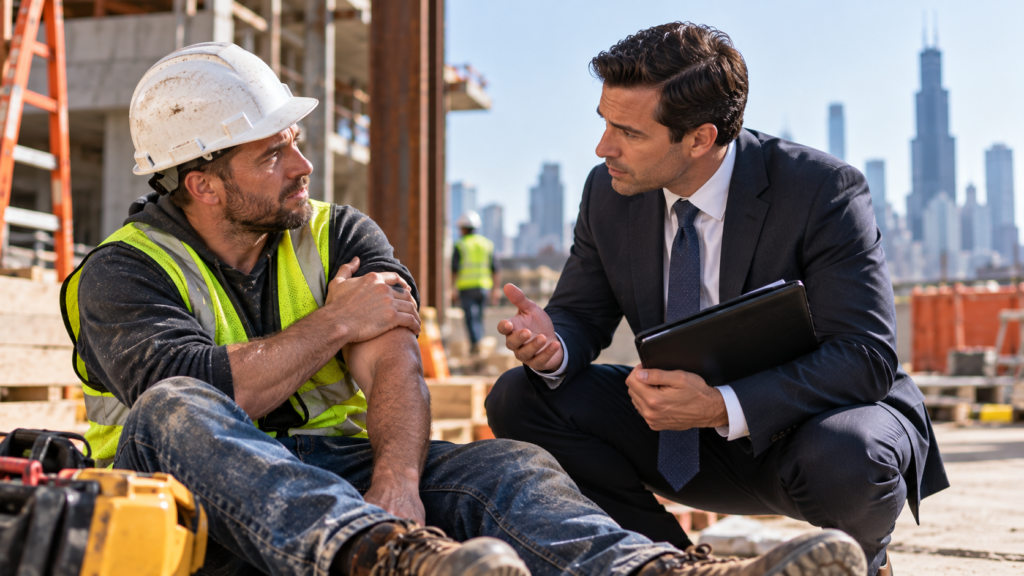
Construction work in Chicago can involve heights, heavy equipment, electrical systems, cranes, traffic, power tools, and several contractors working in the same space. When an accident happens, the injured worker may be dealing with emergency treatment and uncertainty about work while supervisors, insurers, and other companies are already gathering information about what happened.
Knowing your rights early can protect both your recovery and your legal options. A construction injury may involve Illinois workers compensation, a claim against a third party, or both. The correct path depends on who employed you, who controlled the unsafe condition, what caused the accident, and what injuries resulted.
Quick Answer: After a construction accident in Chicago, an injured worker generally has the right to report the injury, seek necessary medical treatment, pursue workers compensation benefits, and investigate whether a negligent third party may also be responsible. Workers should report the accident promptly, preserve evidence, follow medical advice, and avoid assuming that workers compensation is the only possible source of recovery.
What Should You Do First After a Chicago Construction Accident?
Safety and medical care come first. If the injury is serious, call for emergency help and accept appropriate treatment. Even when an injury seems manageable at first, symptoms from head injuries, back injuries, internal injuries, and some fractures can become more obvious later.
After immediate care, report the incident to the employer or supervisor and make sure the basic facts are documented. The firm’s construction injury practice addresses accidents involving scaffolds, ladders, cranes, forklifts, falling objects, roof falls, power tools, fires, explosions, and other jobsite hazards.
If it is safe to do so, preserve photographs of the scene, equipment, debris, safety devices, and visible injuries. Record the names and contact information of witnesses. Do not alter equipment or put yourself at risk to gather evidence.
Do You Have a Right to Workers Compensation Benefits?
Most employees injured in the course of their work in Illinois may pursue workers compensation benefits without proving that the employer was negligent. The system is designed to cover work-related injuries, although disputes can still arise over whether the injury happened at work, what treatment is necessary, and how much disability resulted.
Workers compensation may include payment for reasonably necessary medical treatment, temporary disability benefits while the worker cannot perform the regular job, benefits for permanent impairment, and vocational rehabilitation in appropriate cases. The exact benefits depend on the injury and the worker’s ability to return to employment.
A construction accident can also fit within a broader personal injury case when another party’s negligence contributed to the harm. Workers compensation and personal injury law are different systems, so receiving one type of benefit does not automatically answer whether another claim exists.
How Quickly Should You Report the Injury to Your Employer?
Illinois workers compensation law generally requires notice of the accident to the employer as soon as practicable and no later than 45 days after the accident. Notice can be oral or written, but written documentation can reduce later disputes about when the employer learned of the injury.
The notice should identify the approximate date and place of the accident and make clear that a work injury occurred. Delaying notice can create problems, especially if the employer later argues that the condition came from something outside work.
Reporting the injury is different from filing a formal workers compensation claim with the Illinois Workers Compensation Commission. Those steps have separate deadlines, which is why a worker should not assume that telling a supervisor completes every legal requirement.
Can You Choose Your Own Doctor After a Work Injury?
Illinois law gives injured workers important rights regarding medical treatment, but the exact rules can depend on whether the employer has an approved preferred provider program and how many provider choices have already been made. Emergency treatment is handled differently from later provider selection.
Workers should tell medical providers that the injury happened at work and describe the mechanism accurately. Keep copies of work restrictions, referrals, prescriptions, therapy recommendations, and appointment records. Those documents can affect both treatment approval and disability benefits.
Do not ignore symptoms because you are worried about missing work. Returning too quickly can worsen an injury, while failing to follow medical advice can later create an argument about whether ongoing problems were caused by the original accident.
When Can You Bring a Third-Party Claim?
Workers compensation usually limits an employee’s ability to sue the direct employer for ordinary negligence. A construction site, however, often includes property owners, general contractors, subcontractors, equipment suppliers, delivery companies, and manufacturers. A person or company other than the employer may have created the dangerous condition.
A third-party claim may be possible when another contractor created a fall hazard, a manufacturer supplied defective equipment, a property owner failed to address a dangerous condition, or another company’s employee caused the accident. The specific duty and control over the worksite must be examined rather than assumed from a company’s title.
Some accidents also involve conditions that resemble premises liability injuries, such as unsafe walkways, openings, lighting, or property conditions. Construction cases often require a detailed review of contracts, safety responsibilities, site control, and the sequence of work.
What if You Were Partly at Fault for the Accident?
Workers compensation is generally not based on ordinary fault in the same way as a negligence lawsuit. A third-party personal injury claim is different. Illinois uses modified comparative fault in many negligence cases, which can reduce recovery if the injured person shares responsibility and can bar recovery if the person is found more than 50 percent at fault.
Construction companies and insurers may argue that a worker ignored training, used equipment incorrectly, or entered an unsafe area. Those arguments should be tested against the actual site conditions, available safety equipment, supervision, work instructions, and whether the worker had a realistic ability to avoid the hazard.
Falls are common on jobsites, and the firm’s page on slip and fall accidents shows how property conditions and responsibility can become central issues in injury claims. The facts of a construction fall may be more complex because several companies can share the same work area.
Can OSHA Violations Matter in a Construction Injury Case?
Safety rules and OSHA findings can be important evidence, but an OSHA violation does not automatically decide a civil case. A lawyer may review inspection records, safety plans, training documents, equipment maintenance records, photographs, and witness statements to understand whether required precautions were missing.
The most useful question is not simply whether a rule was violated. It is whether the unsafe condition helped cause the accident and which person or company had responsibility for preventing or correcting it. Construction litigation often turns on control, notice, and the practical way work was being performed at the time of the injury.
Evidence can disappear quickly after a jobsite accident. Equipment may be repaired, debris removed, work completed, and surveillance footage overwritten. Prompt preservation efforts can make a major difference.
What Deadlines Apply After a Construction Accident?
Several deadlines may apply at the same time. Under Illinois workers compensation law, an injured worker generally should notify the employer within 45 days and may have up to three years from the accident to file a claim when no compensation has been paid, or two years from the last payment of compensation when payments have been made, whichever is later.
A separate negligence claim can have a different deadline. Many personal injury claims use a two-year limitations period, while claims based on acts or omissions in the design, planning, supervision, management, or construction of an improvement to real property may involve a four-year discovery period and a ten-year repose rule. Government defendants and other special circumstances can create additional rules.
Because the deadline depends on the defendant and legal theory, general personal injury deadlines should be treated as a starting point rather than a substitute for a case-specific review. Waiting until the shortest possible deadline is close can also make evidence harder to preserve.
What if the Construction Accident Causes a Brain Injury or Death?
Falls from height, falling materials, vehicle impacts, and equipment accidents can cause serious head injuries. A worker may have a traumatic brain injury even without a long loss of consciousness, and symptoms such as memory problems, confusion, headaches, or mood changes can interfere with returning to work.
When a head injury is suspected, the firm’s brain injury practice explains why these claims often require careful medical documentation and attention to long term effects. The financial impact can include treatment, rehabilitation, lost earning capacity, and support needs that continue after the initial recovery period.
If a worker dies because of a construction accident, surviving family members may have workers compensation death benefits and a separate civil claim depending on who was responsible. A wrongful death claim can involve different damages and procedural requirements from a nonfatal injury case.
How Can a Lawyer Investigate a Construction Accident?
A construction accident investigation may require more than a police or incident report. Attorneys can identify the companies on the site, obtain contracts, examine safety responsibilities, preserve photographs and video, inspect equipment, interview witnesses, review OSHA material, and determine which insurance policies may apply.
They can also coordinate the relationship between a workers compensation case and any third-party claim. That coordination matters because payments, liens, medical records, and settlement decisions in one case can affect the other.
The firm’s published construction case results include a multi-defendant construction negligence matter, which illustrates why identifying every responsible party can matter. Prior results do not guarantee a particular outcome, but they show the type of investigation complex jobsite cases may require.
Frequently Asked Questions
Can you sue your employer after a construction accident in Illinois?
Usually, workers compensation is the exclusive remedy against the direct employer for ordinary workplace negligence. There are exceptions and fact-specific issues, while claims against negligent third parties may still be available.
Do you have to report a construction injury even if it seems minor?
Prompt reporting is wise because symptoms can worsen and late notice can create disputes. Illinois workers compensation law generally requires notice to the employer no later than 45 days after the accident.
Can you receive workers compensation and sue a third party?
Yes, in some cases. A worker may receive workers compensation benefits and also pursue a claim against a negligent person or company other than the employer, although reimbursement and lien rules may affect the final recovery.
What if there was no witness to the accident?
A claim can still be possible. Medical records, photographs, equipment condition, electronic records, site documents, and the worker’s consistent account may help establish what happened even without an eyewitness.
Can an employer fire you for filing a workers compensation claim?
Illinois law does not permit an employer to retaliate against a worker for exercising workers compensation rights. If adverse action follows a claim or injury report, the facts should be reviewed carefully because retaliation issues are separate from the injury benefits themselves.
Conclusion
After a Chicago construction accident, an injured worker may have rights under workers compensation law and, in some cases, a separate claim against a negligent third party. Reporting the injury promptly, getting proper medical care, and preserving jobsite evidence can protect those options while the facts are investigated.
The Deratany Law Firm LLC handles serious construction and workplace injury matters in Chicago and across Illinois. If you were injured on a jobsite, the firm can review who was responsible, which benefits may apply, and what deadlines need attention.