
The brain is the most complex organ in the human body, and injuries to it do not always look the way people expect. Unlike a broken bone that shows up clearly on an X-ray, brain injuries can be subtle, progressive, and deceptive. Someone can suffer a significant traumatic brain injury and still appear functional to those around them, at least in the early stages.
Understanding how medical professionals diagnose these injuries matters beyond the clinical context. The diagnostic process creates a medical record that becomes central to any traumatic brain injury claim. The strength and clarity of that documentation often determines the outcome of the legal case that follows an accident.
Quick Answer: Doctors diagnose traumatic brain injuries through a combination of neurological examinations, imaging scans such as CT and MRI, cognitive assessments, and patient history. The severity of the injury is typically classified using scales like the Glasgow Coma Scale, and some injuries require multiple assessments over time before the full picture is clear.
What Causes Traumatic Brain Injuries
A traumatic brain injury, or TBI, occurs when an external force disrupts normal brain function. This can happen from a direct blow to the head, a violent jolt or shaking motion, or a penetrating object. The brain does not need to make contact with a hard surface to sustain a serious injury; the forces involved in sudden deceleration can cause the brain to move within the skull, creating bruising, tearing, and bleeding even with no visible external wound.
In legal contexts, TBIs most frequently arise from truck accidents,
car accidents, construction accidents, and slip and fall accidents. Falls are the leading cause of TBI across all age groups, while vehicle collisions account for the highest proportion of TBI-related deaths.
The Initial Neurological Assessment
When a patient arrives at an emergency department after a head injury, the first step is a structured neurological assessment. Physicians evaluate the patient’s level of consciousness, orientation, and responsiveness. The Glasgow Coma Scale is a widely used tool that scores the patient on eye opening, verbal responses, and motor responses, producing a score that helps classify the injury as mild, moderate, or severe.
A score of 13 to 15 on the Glasgow scale generally indicates a mild TBI, which includes concussions. A score of 9 to 12 suggests moderate injury. A score of 8 or below indicates a severe TBI requiring immediate intensive intervention. This initial classification guides the urgency of subsequent diagnostic steps.
Imaging: CT Scans and MRI
CT scanning
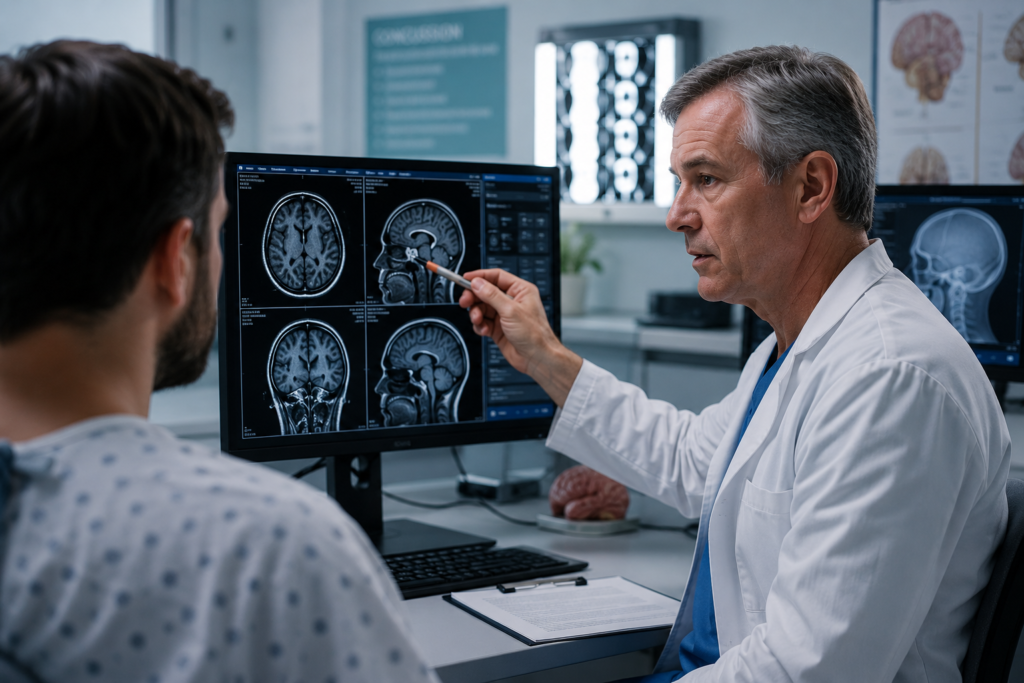
A CT scan is typically the first imaging tool used when a TBI is suspected, particularly in emergency settings. It is fast and effective at identifying acute issues including skull fractures, brain bleeds, swelling, and contusions. CT scans are particularly important for identifying haemorrhages that require surgical intervention.
However, CT scans have limitations. Mild TBIs, including many concussions, produce no visible changes on CT imaging even when the patient is experiencing significant symptoms. A normal CT result does not mean the brain is uninjured.
MRI
Magnetic resonance imaging provides more detailed pictures of soft tissue and is better suited to detecting diffuse axonal injury, small areas of contusion, and structural changes that CT cannot capture. MRI is typically used in the days or weeks following the initial injury once the patient is stable, or when symptoms persist and the CT was inconclusive.
Advanced MRI techniques, including functional MRI and diffusion tensor imaging, are increasingly used in TBI research and in some clinical and forensic contexts to detect connectivity changes that standard imaging misses.
Cognitive and Neuropsychological Testing
Because many TBI symptoms involve cognitive function rather than visible physical damage, neuropsychological testing plays a critical role in diagnosis and ongoing assessment. These evaluations measure memory, attention, processing speed, language, executive function, and emotional regulation.
In mild TBI cases where imaging appears normal, a neuropsychological battery may be the primary tool for documenting the true extent of the injury. These tests establish a baseline and can track whether symptoms are improving or worsening over time, which matters significantly in a legal context where damages are calculated partly based on long-term prognosis.
Symptoms That Prompt Further Investigation
Certain symptoms in the days and weeks following a head injury should prompt additional evaluation even if initial testing appeared normal. These include persistent headaches, difficulty concentrating, memory problems, changes in sleep patterns, mood shifts, and light or noise sensitivity. In the absence of obvious imaging findings, these symptoms are often the primary evidence of a mild TBI.
Patients who downplay these symptoms, or who do not connect them to an earlier injury, may go without a formal diagnosis. This is why careful, thorough medical history-taking after any significant impact to the head is so important.
When Delayed Diagnosis Becomes a Legal Issue
A failure to properly diagnose a TBI can itself give rise to a claim for neurosurgical negligence if a healthcare provider missed warning signs that a competent professional would have caught and acted on. Delayed treatment of brain bleeds, for example, can lead to dramatically worse outcomes that might have been prevented with timely intervention.
In a personal injury case involving a TBI caused by someone else’s negligence, the diagnostic record is foundational to the claim. It establishes the injury, its severity, and its connection to the incident. Gaps in medical documentation can be exploited by defence teams arguing that the injury was less serious than claimed or was not caused by the accident in question.
Frequently Asked Questions
Can you have a traumatic brain injury with no loss of consciousness?
Yes. Loss of consciousness is not required for a TBI diagnosis. Many people sustain significant brain injuries while remaining fully conscious throughout the event. Disorientation, confusion, and memory gaps around the time of injury are also recognised indicators even without unconsciousness.
How long after an injury can a TBI be diagnosed?
Some TBIs are diagnosed days or even weeks after the initial injury, particularly when symptoms are initially mild or attributed to other causes. The absence of an immediate diagnosis does not invalidate a later one, provided there is medical evidence connecting the injury to the traumatic event.
Is a concussion the same as a traumatic brain injury?
A concussion is classified as a mild traumatic brain injury. While most concussions resolve over weeks to months, some produce persistent symptoms known as post-concussion syndrome that can affect quality of life for an extended period. Recurrent concussions carry a greater risk of long-term neurological effects.
What is the difference between a closed and open TBI?
A closed TBI occurs when the skull remains intact but the brain is still injured by forces transmitted through it, such as in a vehicle crash. An open TBI involves a breach of the skull, typically from a penetrating injury. Closed TBIs are far more common in everyday accident scenarios.
How does a TBI diagnosis affect a personal injury settlement?
A documented TBI typically increases the value of a personal injury claim significantly because it adds medical expenses, future care needs, lost earning capacity, and pain and suffering to the damages calculation. The severity of the diagnosis and prognosis directly influence what compensation is appropriate.
The Bottom Line
Diagnosing a traumatic brain injury is a multi-step process that draws on neurological exams, imaging, and cognitive testing, and the results of that process matter far beyond the hospital. If you or a family member has suffered a head injury in an accident caused by someone else’s negligence, having the right legal team alongside your medical team makes a real difference. The Deratany Law Firm LLC works with clients across Illinois on traumatic brain injury cases. Visit the website or reach out to begin a conversation about your situation.