
Every year, thousands of car accidents occur on Chicago streets and the expressways surrounding the city. Some are minor fender-benders that everyone walks away from shaken but physically unhurt. Others involve serious injuries, significant property damage, and legal consequences that take months or years to fully resolve. In either case, the decisions made in the minutes and hours immediately following a crash have real consequences, both for physical safety and for any subsequent legal or insurance proceedings.
Most people go through their entire driving life without being in a serious accident. When one happens, the shock of the moment makes clear thinking difficult. Knowing in advance what the right steps are means you can act on established knowledge rather than trying to figure out the correct response under significant stress and possibly while injured.
Quick Answer: Immediately after a car accident in Chicago, check for injuries and call 911, move vehicles out of traffic if safe to do so, exchange information with the other driver, document the scene with photographs, and do not admit fault or apologise at the scene. Seek medical evaluation even if you do not feel injured, and contact an attorney before speaking with the other driver’s insurance company.
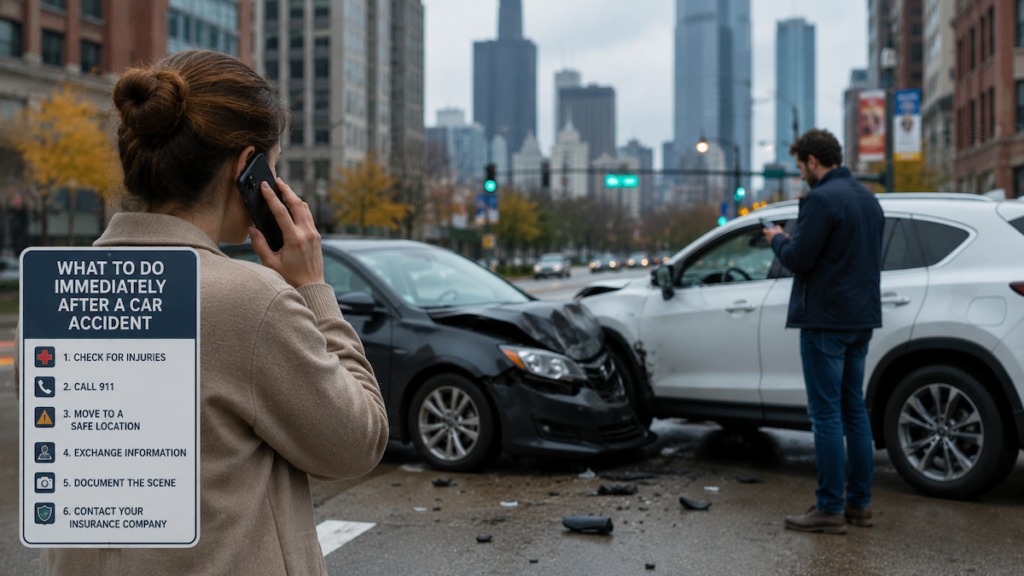
Check for Injuries and Call 911
The first and most important step is to assess whether anyone is injured. Check yourself, your passengers, and if possible the other vehicle’s occupants. Call 911 immediately if there is any injury. In Illinois, you are legally required to call police to the scene if anyone is injured or if there is significant property damage. Even if injuries seem minor, emergency services should be called because some serious injuries do not present symptoms immediately.
This is particularly important with head injuries. Traumatic brain injuries can present with no immediate symptoms and become apparent hours or days after the impact. Someone who walks away from an accident feeling fine can discover a concussion or more serious injury once the adrenaline fades and the swelling sets in.
While waiting for emergency services, stay at the scene. Leaving the scene of an accident in Illinois, particularly one involving injury, is a criminal offense. If the accident occurred in a lane of traffic and it is safe to do so, move vehicles to the shoulder to prevent secondary accidents.
Exchange Information With the Other Driver
You are required to exchange certain information with the other driver following any collision in Illinois. What you need to collect and provide includes full name and contact information, driver’s license number, license plate number, insurance company name and policy number, and the vehicle identification number if available.
Do this calmly and without discussing who was at fault. You are not required to say anything about the cause of the accident, and doing so can be used against you later. Stick strictly to the factual information exchange. If the other driver becomes hostile or refuses to provide information, note everything you can and give that information to the police when they arrive.
Document the Scene
Your phone is one of the most valuable tools you have in the immediate aftermath of an accident. Before vehicles are moved and before any debris is cleared, take photographs of everything: both vehicles from multiple angles showing the full extent of damage, the position of the vehicles in relation to the road, any skid marks or debris, traffic signs and signals nearby, and any visible injuries.
Get the badge number and name of any police officer who attends the scene and confirm when you can obtain the official police report. If there are witnesses, ask for their contact information. Witnesses who give statements while still at the scene provide more reliable accounts than those contacted weeks later, and their perspective on what happened can be critical in disputed liability situations.
What Not to Do at the Scene
The most important thing not to do at the scene is admit fault or apologise, even if you believe you contributed to the accident. Expressions of regret or apology can be interpreted as admissions of liability and can be used against you in insurance negotiations or litigation. This is not about dishonesty: it is about not making legal statements you are not qualified to make at a moment when you do not have full information about what happened.
Do not agree to handle things privately without involving police or insurance. Even if the other driver suggests this and seems sincere, the absence of an official record creates significant problems if injuries emerge later or if the other driver changes their account of events.
Seek Medical Attention, Even If You Feel Fine
Adrenaline is a powerful physiological response that can mask pain and discomfort for hours after a traumatic event. People who feel fine at the scene of an accident sometimes discover significant injuries once the adrenaline dissipates. Neck and back injuries, soft tissue damage, and head injuries in particular can take time to fully manifest.
Seeing a doctor on the same day as the accident, or at most the following morning, creates a medical record that connects your injuries directly to the crash. Gaps in medical treatment are routinely used by insurance companies to argue that your injuries were not caused by the accident, or that they were not serious enough to warrant compensation. A same-day or next-day medical record closes that argument.
Contact an Attorney Before Talking to the Other Insurer
After a car accident, the other driver’s insurance company may contact you quickly to discuss the accident and potentially offer a settlement. Speaking with them before consulting an attorney is one of the most common mistakes people make after a crash. Car accident claims in Chicago involve complexities that are not always obvious to someone unfamiliar with personal injury law, including how Illinois modified comparative fault rules affect recovery when both parties share some responsibility.
An insurance adjuster’s job is to resolve your claim as quickly and inexpensively as possible. Early settlement offers rarely reflect the full value of a claim, particularly when the full extent of injuries has not yet been established. Once you accept a settlement, you generally cannot return to seek additional compensation even if your injuries prove more serious than initially apparent.
Speaking with a personal injury attorney before any recorded statement or settlement discussion with the other insurer protects your ability to recover appropriate compensation for your medical bills, lost wages, and pain and suffering.
The same applies to accidents involving commercial vehicles. Truck accident cases involve additional complexities including federal regulations, multiple potentially liable parties, and insurance carriers with dedicated legal teams whose sole purpose is to minimise payouts.
Frequently Asked Questions
Do I have to call the police after a minor car accident in Chicago?
Illinois law requires police to be called when an accident involves injury, death, or property damage exceeding $1,500. In practice, it is almost always advisable to call regardless of apparent severity, both to comply with the law and to create an official record that protects you if the other driver’s account of events later changes.
How long do I have to file a personal injury claim after a car accident in Illinois?
The statute of limitations for personal injury claims in Illinois is generally two years from the date of the accident. However, there are exceptions and specific circumstances that can shorten or extend this window. Consulting an attorney promptly ensures you do not miss a deadline.
What if the other driver does not have insurance?
Illinois requires drivers to carry uninsured motorist coverage, which provides compensation when you are injured by an uninsured driver. Your own policy’s uninsured motorist coverage becomes available in this situation. An attorney can help you navigate the claim process against your own insurer, which has its own procedural requirements.
Can I still recover compensation if I was partly at fault for the accident?
Yes. Illinois follows a modified comparative fault rule, which allows you to recover compensation as long as you were less than 51 percent at fault for the accident. Your recovery is reduced by your percentage of fault.
What if my injuries become worse after I settle my claim?
Once a settlement is accepted and a release is signed, you generally cannot pursue additional compensation from the same defendant for the same accident, even if your condition worsens. This is one of the strongest reasons to consult an attorney and allow adequate time for the full extent of your injuries to be established before settling.
The Bottom Line
The steps taken immediately after a car accident in Chicago directly shape the safety, medical, and legal outcomes that follow. Prioritising safety, creating documentation, avoiding admissions of fault, seeking medical care, and consulting an attorney before insurance discussions are the actions that protect your interests most effectively.
The Deratany Law Firm LLC represents car accident victims throughout Chicago and Illinois. If you have been injured in a car accident and have questions about your rights, reaching out for a consultation is a good first step.