
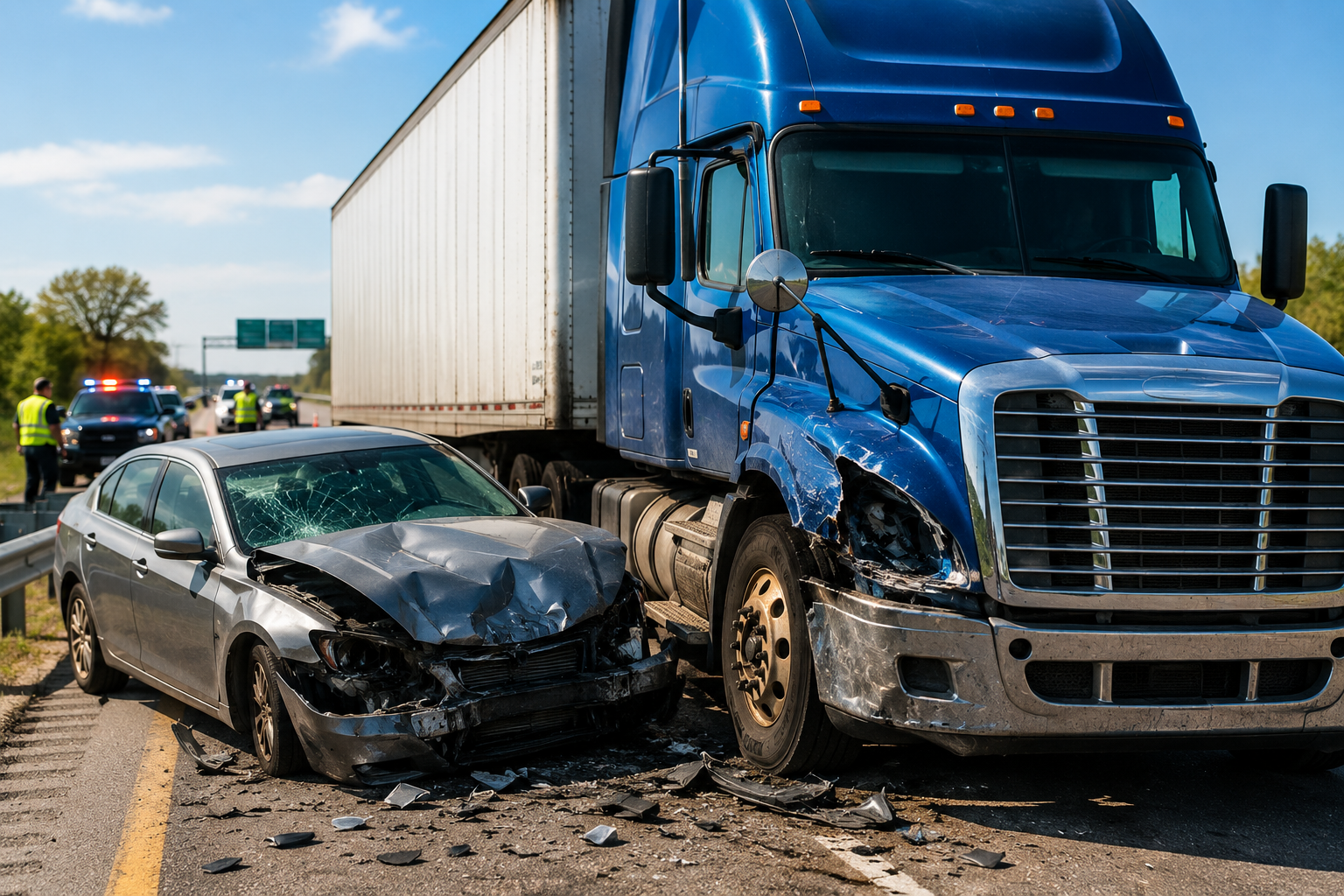
A collision with a semi-truck is one of the most serious types of vehicle accidents that can occur on an Illinois highway or city street. The sheer mass and momentum of a loaded commercial truck creates impact forces that far exceed what a passenger vehicle can withstand, and the resulting injuries tend to be severe. When someone is seriously hurt or a family loses a loved one in a truck accident, one of the first and most important legal questions that arises is who can be held responsible.
Truck accident liability is often more complex than standard car accident liability because multiple parties may have contributed to the crash or to the conditions that made it possible. The driver is the most obvious candidate, but the trucking company, the cargo loader, the vehicle maintenance provider, and even the truck’s manufacturer may each hold a share of legal responsibility depending on the specific facts of the case.
Quick Answer: In a semi-truck accident in Illinois, liability may fall on the truck driver, the trucking company, the cargo loading company, the vehicle maintenance provider, or the truck manufacturer, depending on what caused the crash. Illinois law allows multiple parties to be held jointly liable, which means a thorough investigation of all contributing factors is necessary to identify every responsible party and maximise the compensation available to an injured victim.
The Truck Driver
Driver error is the most common cause of commercial truck crashes. Common forms of driver negligence in truck accidents include fatigued driving in violation of federal hours-of-service limits, distracted driving, driving under the influence, speeding or aggressive driving, and failure to check blind spots before changing lanes or merging. When driver negligence caused or contributed to the crash, the driver is personally liable.
However, the driver’s personal assets are rarely sufficient to compensate for the severity of injuries in a serious truck crash. This is why pursuing liability against the employer, the trucking company, is typically a central focus of any truck accident claim.
The Trucking Company
Trucking companies can be held liable for accidents caused by their drivers under the legal doctrine of respondeat superior, which holds employers responsible for the negligent acts of their employees performed in the course of employment. For most commercial truck drivers operating under company authority, this doctrine applies directly. Truck accident claims frequently name the trucking company as a primary defendant because commercial carriers are required to carry substantial liability insurance, making them a more practical source of compensation than the driver alone.
Beyond vicarious liability for driver negligence, trucking companies can be directly negligent in their own right. Failure to conduct adequate background checks on drivers, failure to enforce hours-of-service compliance, pressure on drivers to meet delivery schedules that incentivises unsafe driving, inadequate training, and negligent retention of drivers with problematic records are all forms of direct corporate negligence that support an independent liability claim against the company.
The Cargo Loading Company
Improperly loaded, secured, or distributed cargo is a significant cause of truck accidents. Cargo that shifts in transit can alter the truck’s centre of gravity, causing rollovers or making the vehicle impossible to control in emergency situations. Overloaded trucks exceed their designed handling capacity. Unsecured loads can fall onto the roadway, creating hazards for other vehicles.
When cargo loading was performed by a third-party company rather than the trucking company itself, that loading contractor may bear direct liability for a crash caused by their negligent work. Identifying who performed the loading and what standards they were required to follow is a critical part of the investigation in any crash where cargo configuration is a possible contributing factor.
Vehicle Maintenance Providers
Federal regulations require commercial trucks to be maintained to specific safety standards, and mechanical failures, including brake failures, tyre blowouts, and steering system failures, are among the documented causes of serious truck accidents. When a mechanical failure contributed to a crash, the question of who was responsible for maintaining that system is directly relevant to liability.
The maintenance obligation may rest with the trucking company, with a third-party maintenance contractor, or with the leasing company if the truck was leased rather than owned by the carrier. Maintenance records, inspection logs, and repair histories are all key evidence in establishing where maintenance negligence occurred and who bears responsibility for it.
The Truck Manufacturer
When a design or manufacturing defect in the truck or one of its components contributed to the crash or worsened the injury, the manufacturer may be liable under products liability law. Defective braking systems, defective tyres, cab design that failed to provide adequate protection in a rollover, or defective safety systems are all potential bases for a product defect claim.
These claims involve different legal standards from negligence claims and typically require expert analysis of the component’s design and the manufacturing process. They can be pursued alongside negligence claims against the driver and company rather than as an alternative to them.
Federal Regulations and How They Affect Liability
Commercial truck drivers and carriers are regulated by the Federal Motor Carrier Safety Administration, which sets standards for driver qualifications, hours of service, vehicle maintenance, cargo securement, and drug and alcohol testing. A violation of any FMCSA regulation at the time of a crash is significant evidence of negligence in a civil case. Attorneys handling truck accident claims routinely request all regulatory records and logs to identify violations that support the liability analysis.
The injuries sustained in a serious vehicle accident involving a commercial truck are frequently catastrophic in severity, and the full value of a claim must account for long-term medical costs, lost earning capacity, and the ongoing impact on quality of life.
Among the most serious injuries in truck accidents are traumatic brain injuries, which can have permanent effects on cognitive function, personality, and the ability to work and live independently.
Consulting a personal injury attorney with specific experience in commercial truck accident litigation is essential because these cases require early evidence preservation, regulatory compliance analysis, and the resources to investigate multiple potentially liable parties simultaneously.
Frequently Asked Questions
How long do I have to file a truck accident lawsuit in Illinois?
The general statute of limitations for personal injury claims in Illinois is two years from the date of the accident. Claims against government entities may have shorter notice requirements. Acting promptly is important because evidence including driver logs, black box data, and surveillance footage may be overwritten or lost if not preserved quickly.
Can I sue both the driver and the trucking company?
Yes. Illinois law allows claims against multiple defendants in the same lawsuit. Both the driver and the trucking company are typically named as defendants in truck accident litigation, along with any other parties whose negligence contributed to the crash.
What evidence is most important in a truck accident case?
The truck’s electronic logging device and black box data, the driver’s hours-of-service records, drug and alcohol test results, the truck’s maintenance and inspection logs, cargo weight and loading records, witness statements, and the police accident report are all critical evidence. Much of this evidence must be preserved through legal action quickly after the crash.
Does the trucking company’s insurance cover my injuries?
Commercial carriers are required to carry minimum liability coverage under federal law, typically $750,000 to $5 million depending on what cargo the truck carries. These policy limits are substantially higher than personal auto insurance limits, which is one reason truck accident settlements can be significantly larger than standard car accident settlements.
What if the truck driver was an independent contractor, not an employee?
When a truck driver operates as an independent contractor rather than an employee, the analysis of the carrier’s liability changes but does not necessarily eliminate it. Courts and regulators look at the level of control the carrier exercised over the driver’s work to determine whether employer liability applies. An attorney experienced in commercial trucking cases can assess the specific facts.
The Bottom Line
Semi-truck accident liability in Illinois is rarely limited to a single party. The driver, the trucking company, cargo loaders, maintenance providers, and manufacturers can all bear responsibility depending on the facts, and identifying every liable party is essential to recovering full compensation for serious injuries.
The Deratany Law Firm LLC represents truck accident victims throughout Illinois. If you or a family member has been injured in a truck accident, reaching out for a consultation is the first step toward understanding your options.