
Riding a motorcycle through Chicago traffic takes a level of awareness that drivers in enclosed cars rarely have to think about. Lane splitting decisions, sudden lane changes from distracted drivers, and door zones near parked cars all demand constant attention, and even the most careful rider can end up in a crash caused entirely by someone else.
When that happens, many riders assume they will be treated less fairly than someone injured in a regular car accident, simply because of an existing bias against motorcyclists. That assumption is understandable, but it does not reflect what Illinois law actually says about a rider’s rights after a crash.
Quick Answer: Motorcycle accident victims in Chicago have the same legal rights as any other injured driver, including the right to file a claim for medical expenses, lost income, pain and suffering, and property damage. Riders are protected from unfair bias based solely on the fact that they were on a motorcycle, and Illinois’ comparative fault rules apply to motorcycle claims exactly as they do to car accident claims.
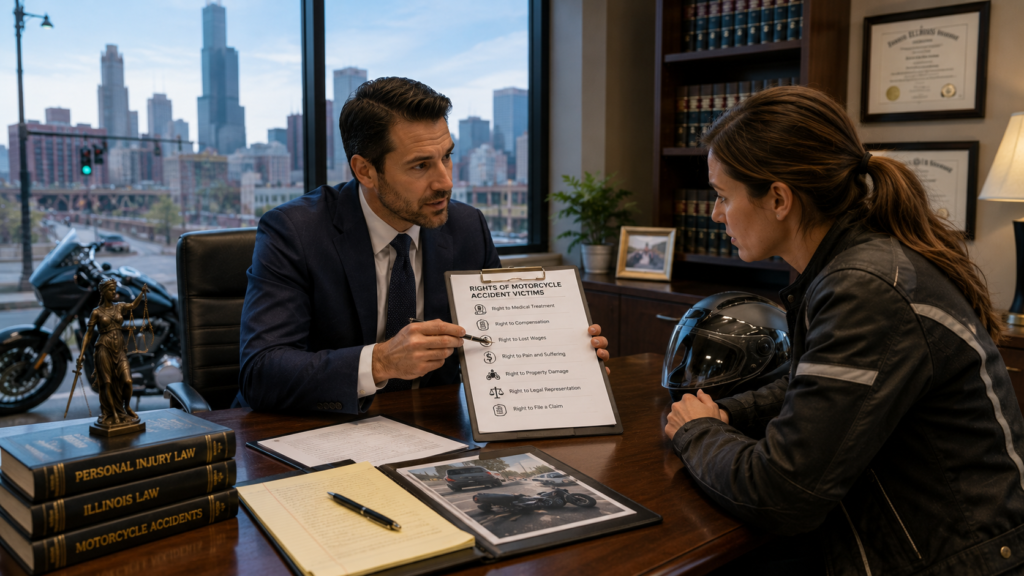
The Right to Full Compensation, Not a Reduced Standard
Illinois law does not treat motorcyclists differently from any other injured party. A rider hurt by a negligent driver has the same right to pursue a motorcycle accident claim covering medical bills, lost wages, property damage to the bike, and pain and suffering as anyone injured in a passenger vehicle. Insurance adjusters sometimes lean on the stereotype that riders are inherently reckless to justify a lowball offer, but that assumption has no basis in the actual law governing fault.
Why Insurers Often Undervalue Motorcycle Claims
Motorcycle crashes tend to produce more severe injuries than comparable car accidents because riders lack the protection of a vehicle frame, airbags, and seatbelts. Insurers know this, and some use the severity of the injury combined with rider stereotypes to argue that the victim was speeding, lane splitting improperly, or otherwise contributing to the crash, even when the evidence does not support that. Riders who understand this tactic ahead of time are better positioned to push back on an unfair initial offer.
The Right to Pursue the At-Fault Driver Directly
The majority of motorcycle crashes involving another vehicle happen because a driver failed to see the rider, often at intersections or when changing lanes. When that failure to see and yield causes a crash, the rider has the right to hold that driver financially responsible through an insurance claim or a lawsuit if a fair settlement cannot be reached. This applies whether the crash happened downtown, in a residential neighborhood, or on the expressway.
How Comparative Fault Applies to Riders
Illinois uses a modified comparative fault system that applies equally to motorcycle and car accident claims. A rider can still recover compensation even if they share some responsibility for the crash, as long as their share of fault is 50 percent or less, though the total award is reduced by that percentage. This means a rider who was riding legally and defensively but happened to be traveling slightly over the speed limit at the time of a crash caused primarily by a distracted driver can still recover a significant portion of their damages.
The Right to Compensation for Serious and Long-Term Injuries
Because motorcycle crashes frequently involve high-impact forces, riders often face injuries that car accident victims are less likely to sustain, including road rash, fractures, spinal injuries, and traumatic brain injury. Riders have the right to seek compensation not just for immediate medical treatment but for the full scope of long-term consequences, including future surgeries, ongoing therapy, and lost earning capacity if the injury affects their ability to work.
The long term effects of a TBI in particular can take months to fully understand, which is why riders should be cautious about settling a claim before a doctor has a clear picture of their recovery trajectory. A brain injury that seems mild in the emergency room can develop into a persistent condition affecting memory, concentration, or mood weeks later.
The Right to Recover Damages Even Without Insurance on the Bike
Riders sometimes assume that a lapse in their own insurance, or riding without the maximum required coverage, eliminates their right to sue an at-fault driver. This is generally not the case in Illinois. A rider’s right to pursue the at-fault driver for damages exists independently of their own insurance status, though carrying adequate coverage still matters for situations involving an uninsured or underinsured driver.
What to Do Immediately After a Chicago Motorcycle Crash
The steps a rider takes in the hours and days after a crash have a direct effect on the eventual value of a claim. Riders should get medical attention immediately, even for injuries that seem minor, since some soft tissue and neurological symptoms take time to appear. Documenting the scene with photos, gathering witness contact information, and avoiding early statements to an insurance adjuster about fault all help preserve the strength of a later claim. Understanding how to cover medical costs in the meantime, whether through personal insurance, MedPay, or a claim against the at-fault driver, is also part of protecting a rider’s financial position while the case develops.
These situations only scratch the surface of the common injury claim questions that come up after a Chicago motorcycle crash, and the specifics of each case can shift the answer.
Frequently Asked Questions
Can I still recover damages if I wasn’t wearing a helmet?
Illinois does not have a universal helmet law for adult riders, so not wearing one is generally not treated as fault in a crash caused by another driver. It may become relevant only if the lack of a helmet is shown to have worsened a specific head injury.
Do Chicago motorcycle claims work differently than claims in the suburbs?
The underlying Illinois law is the same statewide, though claims in Chicago often involve additional complexity around city traffic patterns, intersection design, and municipal liability if a road defect contributed to the crash.
How long do I have to file a motorcycle accident claim in Illinois?
Most motorcycle injury claims must be filed within two years of the crash date, though property damage claims and cases involving a government entity can carry different or shorter deadlines.
What if the at-fault driver has no insurance?
Riders with uninsured or underinsured motorist coverage can pursue a claim through their own policy in this situation, and an attorney can also help identify any other potentially liable parties, such as an employer if the driver was working at the time.
Will my claim be affected because I was lane splitting?
Lane splitting is not legal in Illinois, so engaging in it at the time of a crash can be used as evidence of fault, though it does not automatically bar a rider from recovering compensation if the other driver’s conduct was still the primary cause of the crash.
The Bottom Line
Motorcycle accident victims in Chicago hold the same fundamental rights as any other injured driver, and riders should not accept a reduced settlement based on assumptions about who was at fault. Understanding these rights, and acting on them quickly after a crash, makes a meaningful difference in the outcome of a claim.
The Deratany Law Firm LLC represents injured riders throughout Chicago and pushes back against the bias that insurers sometimes use to undervalue motorcycle claims. If you were hurt in a crash that was not your fault, a conversation about your options is a reasonable next step.